14 August 2012

Does your investment made the best choice in CEE countries?(Part1)


As we know the Central East Europe contains Poland, Hungary, Czech, Slovakia, Slovenia, Romania, Bulgaria, Serbia, Croatia, Bosnia etc. 13 countries with total area 117 square kilometers, population over 120 million which has total GDP around 0.9 billion dollar, total foreign trade 0.89 billion dollar. This area has pretty strong foundation in various industries such as motor industry, generating equipments, mining as well as aircraft manufacturing, shipbuilding, even on biotechnology, pharmacy and also has advantage in producing agricultural products and grape wine.  All of these industries experienced a rapid development since 7 of them (Poland, Hungary, Czech...) entered the EU, and becoming more competitive.


From now on, let me specifying some dominant industries and put them into these main CEE countries which has dominant in each industry as well.


No.1: Motor industry

Czech Republic:

Since the data shows motor industry already has over 100 years history in Czech Republic, it is the most important department in processing industry there. It also takes 20% in its economy which makes car being the major export product and the export has topped 9% of the total export in Czech. Škoda is the main place they produce cars, its annual output has reached 500,000 cars and selling to all over the world, obviously it became the bellwether in its field. Nowadays, the first car “Octavia” which corporate with Shanghai Volkswagen was coming to the market. Not only in small cars but coach has taken a competitive position in West European market. We can see the biggest coach producing factory is Karosa there.

In addition, more than 40 car manufacture out of the top 100 has set the branches in Czech.


Poland:

Since 1990, the motor industry has developed well in Poland by absorbing foreign investment. The output of cars and export continuously increasing, the product quality and level of skills has improved as well, Poland became the No.8 car-making country in Europe, just after Russia, Czech and Sweden. The three biggest manufacturers are Fiat, Opel and Volkswagen which are well-known by all of us. The high criteria for fitting technology and various devices to choose give incentives for famous company investing there.


Slovakia:

Motor industry takes a pretty important strategic position in Slovakia. Volkswagen AG is the most powerful enterprise there, some well-known manufacturers like the PSA from France and the Kia from Korea has also invest plants there. In 2006, these three manufacturers has producing 295390 cars in total which occupies 28.4% of total industrial output. Except investing in plants, the fittings became attractive too, the investment of fitting keeps climbing. The worldMarkets Research Centre(WMRC) says Slovakia and India, Thailand, Iran as well as Czech are the most attractive countries of motor industry, they will be the center for developing new cars in the near future.


Hungary:

Motor industry is a traditional industry in Hungary. Since 90s of 20th century, car and its fitting industry got rapid development and became the main pillar of Hungarian motor industry, the foreign investment takes a huge portion. In 1992, the Suzuki from Japan set the first manufacturer in Hungary, then Opel Germany in 1994, Audi in 1997. Audi started car assembling since 1998 but not just producing the engine. The General Motor is producing automobile gearbox for all European countries as well as exporting to China.


Romania:

The industrial base in Romania is very well. It mainly has Dacia, Oman, Roman Corporation. Dacia started producing Renault(Romania) and named it as DACIA 1300, this car kept its production around 35 years. In 1999, Renault purchased Dacia, and then produced SuperNova and Solenza in 2000 and 2003. In 2004, Dacia offered an economic car which called Logan, it was acclaimed by the market. However the Roman Corporation stopped its production under a fierce competition in the market, now they are looking for the substitution.


All of these helped CEE countries in increasing more working position.


No.2: Environmental Protection Technology and Equipment:
In CEE countries for example Hungary, Czech and Slovakia, they have pretty high level in dealing with industrial sewage, waste disposal and microbiological treatment.
        Here I mention the R-AN-D-N technology from Czech, which is widely used in different area. Also the USBF technology to processing the sewage, it has applied in so many countries such as USA, Germany, Italy, Canada, Spain and so on.


No.3: Pharmacy

Hungary:

It has more than one year history and it became one of the most competitive industry in Hungary.

There are more than 20 pharmaceutical factory, The biggest one IS Richter Gedeon. This company has over 100 products and 140 kind of preparation. This company has its own R&D department and producing medicine by their own, these products can apply for all the therapeutic area. Two third of its products has sent to over 100 countries.

Egis pharmaceutical factory is the second biggest one in Hungary which has a long history.


Chinoin ranks the third one, it exporting its products to more than 80 countries.


See more please check the following article(part2).


Source&Links:


http://en.wikipedia.org/wiki/Motor_industry

eepcindia.org/bulletin/b20050810/OMI.pdf

www.iese.edu/research/pdfs/DI-0920-E.pdf

03 August 2012

Is it hard to creat the superiority of Chinese talent in electronic industry?


It is quite a controverisal topic to mention, people will ask “is there any superiority of talents in China” rather than “is it hard to create it in China”.

Since China do not take any advantage in high end electronic core technology, furthermore, we can say China has pretty huge gap in core technology comparing with others such as a country like United States. However, a lot of skilled worker appears there with the trend that global electronics manufacturing industry shifting to China. The scale-up pattern let China got the talent advantage consequently.

The multinational semiconductor suppliers are saying China has the smartest electronics engineer as we can always see from the articles and magizines. However it does not mean China holds the competitive advantage even if they have amount of skilled workers (or people call them blue collar workers) in electronic designing.


Nowadays do you know what are these skilled engineers doing everyday? Repeating amount of similar designing work or making the so called creative product which driven by latest devices. There are several electronic devices to choose on the prefect competition market, the engineers just need to follow the white book then apply any kind of device into their product. Although the various devices provide better choice, it is not good for Chinese engineers to make deeper research in a certain chip or a single component. Of course the new ideas to make amazing product appearing every single moment in their mind, however they lost the chance to compete in the market just because the use and choose of device is not serious enough so that the costs are not effectively saved.

For this let’s see an example, the iPhone from Apple. People dismantled iPhone found there are not such new or advanced components, while all the components can be found on the market and available, the only difference is the engineer put more efforts and deeper technical analysis into it. Finally, iPhone comes to our life, the society accept it.


Well, think from another side, abundant skilled engineers provides a stable basis for the development in  electronic industry, if you are an investor, trust them coz as long as some of their engineers start to look deeper, focusing on a specific area, you will see the great effect; if you are an emerging country as well, the situation in China will let it be a worthy opponent; if you are just a bystander, well then let’s wait and see, no one knows better than the market.


10 July 2012

Low-cost manufacturing in Western Romanian electronics cluster

The emerging Western Romanian electronics cluster provides a super low-cost manufacturing in a relatively good infrastructural environment.

 Emerson's Cluj factory

The Timisoara-Arad-Oradea-Satu Mare-Cluj bordered area is located in the Northwesten part of Romania, closed to the Hungarian border. The motorway access of the location is solved by the Hungarian M3 and M5 motorways, and by the large-scale Romanian motorway developments in the future. International airports in Cluj and Timisoara provides more sheduled flights to the main European hubs.


Western Romanian electronics cluster

Leading companies


More OEM and EMS companies are present in North Western Romania. In the second largest Romanian city, Cluj, the US-based Emerson has a facility with 3,500+ employees, manufacturing gas regulators, electric equipment  for explosive environments, equipments and devices for construction site facilities, high power electrical generators. The cell phone company, Nokia, just closed its Cluj facility at the end of 2011, and more than 3,000 well-trained employees lost their jobs. The Flextronics' factory in Timisoara has an emphasis on automotive, medical, industrial and networking market. At spring 2012, the US-based Plexus expand its Oradea activity, increasing local employement to 500 jobs.

Labour markets

Romania is regarded as "super low-cost" location. That's absolutely right in many cases: the annual gross salary for operators in electronics manufacturing industry is around €2,500, lower than in Coastal China. The union movements are generally weak in Eastern Europe, and almost not exist in Romania.
However, in some cases, like special technical, engineering skills etc, the labour supply can be very limited, and these key employees can reach a Western style wages. Notice: before the crisis, Oradea has the lowest unemployment rate in Romania.

Business parks

Based on CBRE MarketView, Timisoara, Arad, Cluj has a relevant share in Romania's 1.4 million sq.meter overall industrial real estate stock. Tetarom Inc. provides 3 business parks in Cluj: the Tetarom 1-2-3 have approx. 200 hectare industrial lands. Tetarom parks are focusing on high tech industries like IT, automation, robotics, and first of all electronics. The Freidorf Industrial Park in Timisoara, managed by the local municipality, provides a special low-cost land leasing for investors. The Euro Business Park, Oradea is also managed by the local municipality, and with its 121 hectares area, one of the largest business park in Western Romania.
The average rental fees for industrial manufacturing halls are between 3-4 € per sq.meter per month (3.3-4.4€ per sq.feet per year), following the Eastern European average cost level.

A short video about the end of Nokia's Cluj factory:

14 June 2012

The best electronic logistic hubs in Eastern Europe

Electronics manufacturing requires a strong logistic support, to organize the supply chain as cost-effective as possible. The Eastern European electronics industry is served from some matured and some emerging hubs.

Hungary

 M0 Motorway, Hungary

Budapest. The main logistic hub of Hungary (and maybe Eastern Europe) is Budapest. The M0 Motorway around the City is not a bypass only, but the location of several logistic parks and warehousing companies, developing ~3 million sq.meters (approx. 32 million sq.feet) industrial and logistic facilities. The US-based Prologis is the market-leader service provider in Hungary, and has almost 500k sq.meter (~5,3 million sq.feet) warehousing spaces in more logistic parks along the M0.

 Delivery times from Polgar

Polgar. The emerging hub of Polgar Industrial Park is located directly at the Polgar-exit of M3 motorway. The Polgar Industrial Park provides a north-south (Poland to Romania) and east-west (Ukraine to Western Europe) delivery routes, 3 borders (Slovakia, Ukraine, Romania) can be reached in 90-120 minutes by truck. The Industrial Park of the Year has a logistic program, including 120k sq.meter (1.3 million sq.feet) industrial and logistic hall development for the next 5-10 years. Subsidized rental fees are under 3€/sq.meter/month (under 3.3€/sq.feet/year).
More electronics companies has located its logistics support to Polgar. Jabil Curcuit, the leading US-based EMS provider, has its hub and consignation storages in Polgar Industrial Park. The storages on 5k sq.m support the manufacturing units in Ukraine and Hungary.

Poland


Poland's logistics map 2012


The polish logistic market is devided in 3 parts: the Sector I is the City of Warsaw, Sector II are the logistics parks around Warsaw, and Sector III are the logistic locations outside Warsaw. Although the Warsaw-sectors with ~2,5 million sq.meters are the largest logistics sites of Poland, the electronics industry are supported mainly from smaller hubs, like Lodz, Poznan, Krakow and Wroclaw. Average rental fees are between 3-3.5 €/sq.meter/month.

Lodz. Lodz is located in the cross-road of north-east A1 motorway and the east-west A2 motorway, in the Lodz-Poznan-Bydgoszcz electronic manufacturing triangle. More logistics-focused facilities provides A-class warehouses for electronics industry on 1 million sq.meters. The Goodman Lodz Logistic Centre has 27k sq.m total size, and the Logistic City in Piotrkow (Lodz Metro Area, closed to Lodz International Airport) with its 450k sq.m is one of the largest facility in Poland.
Wroclaw. Wroclaw (or its old German name: Breslau) is located in the South-Western corner of Poland, called 'Silesia', at the A4 motorway. It is a well known manufacturing centre with electronics companies such as Whirlpool, LG Philips, Siemens and many others. One of the leading service provider is Panattoni Logistics Park.

Czech Republic

 Czech logistic market 2012

Just like the Czech electronics industry, the electronics logistics is focused in two hubs: the capital city Prague and the 2nd largest city, Brno. These cities have strong transportation connections, developed industrial/logistics real estate markets and supportive authorithies.

Prague. The logistic centres around Prague are available for 2.5-4.5€/sq.meter/month (2.8-5€/sq.feet/year) rental fees. The Airport Logistic Park has a 56,000 sqm hall development in the surrounding of Prague International Airport.
Brno. Brno, the second largest city of the country is also the centre of electronics manufacturing industry, representing companies like Acer, Honeywell or Siemens. The city provides good infrastructure, strong technical education - and at last but not least an excellent logistic support. The CEE market leader Prologis will launch soon a brand new development called Prologis Logistic Park Brno on 90,000 sq.meter


03 May 2012

5 reasons to start electronics manufacturing in Eastern Slovakia


Slovakia is the 3rd most relevant electronics manufacturing country in Central- and Eastern Europe, achieving 60,000+ employees in 2012. Eastern Slovakia provides more benefits for newcomming electronics companies.


#1: Developed transportation infrastructure

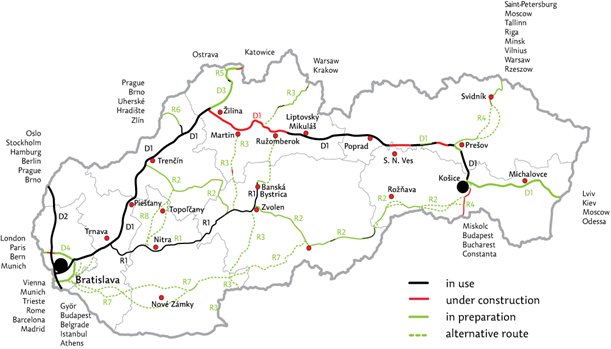
Eastern Slovakia can be reached via D1 motorway (and also via M3 motorway in Hungary).


The Kosice International Airport has daily flights to Vienna, Prague and Bratislava. The motorway access + the daily airflights to main hubs are a rare combo in the low-cost locations of CEE.

#2: Large labour supply

Eastern Slovakia has a proven track record in electronics industry, representing companies like Panasonic, BSH or Tesla (see the map), but not overloaded with competing electronics companies than Western Slovakia, Western Hungary or some Czech regions.
Eastern Slovakia has an unemployed rate over 18%, much higher than e.g. the Western Romanian electronics cluster has. It means low labour costs, low wage inflation and good HR costs projection opportunities.

#3: Focused education

There are over 40 secondary and vocational schools with specialisation on electrical engineering in Slovakia. Number of secondary school student in the field of electrical engineering and related studies is 25,000. And there are over 27,000 students (2,000 doctoral studies students) at 4 universities oriented towards electronics and electrical engineering industry. (source: Sario, 2011)

The Technical University of Kosice has 2,500 students on electronics and IT engineering, 1,000 students on manufacturing technologies, and the university also provides studies on mechanical engineering, aeronautics or economics.

#4: Full infrastructure real estate options


The Kechnec Industrial Zone is located south from Kosice, closed to the Hungarian border. The business park is one of the most successful facilities in Slovakia and Central- and Eastern Europe. The large (332 hectares/820 acres) business park has large scale infrastructure, good labour market conditions (between two metropolitan areas, Kosice and Miskolc, Hungary). Electronics companies like Magneti Marelli, IEE Sensing are running business in Kechnec.

ImmoPark Kosice belongs to the Austrian banking group Erste. The project with the total area of 60 hectares next to the Kosice Airport will offer over 250.000 sqm of lettable area. The halls were designed to fit any special requirements. The first phase will be available from Q3 2012.

#5: Governmental incentives are focusing on Eastern Slovakia

The Slovakian Act on Investment Aid defines the framwork of national incentives in Slovakia. The incentives are provided in the form of:
a) a subsidy for the acquisition of material assets and immaterial assets,
b) an income tax relief,
c) a contribution for created new jobs,
d) transfer of immovable property or exchange of immovable property at a price lower than a general asset value

The goal of governmental incentives is to orient foreign direct investments into underdeveloped regions with high unemployment. One of the main target area is Eastern Slovakia, so prepare for a pleasant surprise thinking about investing there.

-----
About Sario
The Slovak Investment and Trade Development Agency (SARIO) is a government-funded allowance organization that works under the supervision of the Ministry of Economy of the Slovak Republic. SARIO’s primary objective is to improve the standard of living of Slovak citizens by increasing employment and reducing regional disparities.

After the first international award for SARIO, the ‘European IPA Award‘ of 2003, the international prestige of foreign investment’ services delivered by the Slovak Investment and Trade Development Agency was recognized again in 2007 when SARIO won ‘Best European Investment Agency Award for High-Tech‘ at the World Investment Conference in La Baule (France).


Slovakia - Global Best to Invest 2010
by Site Selection Magazine 2011