Showing posts with label czech republic. Show all posts

25 September 2012

Government grants in Eastern Europe to boost electronics manufacturing

Electronics manufacturing is a prefered, strategic industry in almost all Eastern European countries. It means, when you establish here a new manufacturing plant, you can expect more "good points" from governments, which concludes higher grants.

Generally we can say, Eastern European governments' threshold stimulus is around 10 million euros investment and approx. 100 new jobs in electronics industry, under these numbers you are a very small investor. Governments normally sign an agreement with investor, so receiving a government grant is a contractual connection between the company and the government. It means, you get some money, but you also have some obligations, e.g: for job creation money you have to employ your staff for 1-2 years - and when you could't, you have to pay back the grant.
The subsidizing process always starts at the governmental investment promotion agencies: the PAIZ in Poland, The HITA in Hungary, the CzeckInvest in the Czech Republic, the Sario in Slovakia, and the RomTradeInvest in Romania. Decision making about the government subsidy requires normally 1-3 months.
There are several dues you can apply for, here we overview the most important:

#1 Real Estate development subsidies
Fundamentally there are 2 types of property grants: a) transfer of industrial land at a discount (e.g: in the Czech Republic) and b) building subsidies (e.g: in Hungary). When you think about real estate grants, do not forget: real estate business is a particular profession, and real estate costs are approx. 10% only of the total investment - it's much easier to lease a property on a subsidized fee.

Case study: subsidized leasing in Polgar, Hungary Polgar Industrial Park, Hungary won an EU grant in 2012 for development of a new, 7,000sq.meter (75,000 sq.feet) manufacturing hall, available from Q4 2012. The grant provides a leasing fee discount for potential investors, and in the meantime they don't have to invest in a real estate.


#2 Machinery purchasing grant
Most countries do not separate the real estate and machinery grants - they simply subsidizes investments in "assets". The machinery can be the main "eligible cost" of investment projects, e.g in the Czech Republic, "a basic condition is a minimum investment in long-term tangible and intangible assets in the amount of CZK 50 million in Regions I, of which at least CZK 25 million must be invested in new machinery, and  CZK 100 million in Regions II, of which at least CZK 50 million must be invested in machinery, whereas at least half of the minimum investment amount must by financed with the investor’s own capital." (CzechInvest's brochure 2012) 

#3 Job creation and other HR-related subsidies
The G-spot of Eastern European governments is job creation, this is the magic word you should build on. Many countries simply provides a "head money" for each new job created. For example, if you invest 40 million Polish Zloty (approx. 10 million EUR) in Poland, AND create 250 new jobs in electronics, the Polish government will grant you 800-3900 EUR per new jobs. The final job creation grant in Poland depends on the number of new jobs created, the percentage of employees with higher education, location, attractiveness of the products on the international markets etc. Other governments subsidize also smaller costs (e.g: employees' commuting cost in Hungary, training costs in many countries etc), but these are the typical schemes.

#4 Tax relieves
Eastern European governments are a bit shy when its about tax relieves. Before EU accession, most government provided large scale corporate income tax relieves, but the European Union doesn't like it indeed. However, most of the governments found smart, EU-compatible solutions for tax relieves. For example, the Hungarian government provides "development tax allowance", with the following scheme:
  • Amount of subsidy: exemption for 80% of the corporate tax payable for 10 years following installation. Up to HUF 500 M turnover the corporate tax rate is 10%, above HUF 500 M the tax rate is 19%.
  • Conditions: investment volume min. HUF 3 B (EUR 11.3 M), min. 150 new jobs OR HUF 1 B (EUR 3.7 M) investment volume and 75 new jobs in preferred regions
  • Application: depending on investment volume request or application needs to be submitted
  • Provider of incentive: Ministry for National Economy

#5 Cash grants
In the love packages of Eastern European governments there is two types of cash. All the grants above have specific goals, preferences, and obligations (e.g: re-training grants have to spend for local trainings), but when you hear about "cash grants" it means in general: you get money (normally not more than 5% of total investment costs) as a bonus.

The European sandbox
Finally: the government grants ("state aid" in European jargon) are generally prohibited by European Commission (the "federal government of EU"), because government grants have a negative impact on internal market competition. However, there are some exceptions, when EU not prohibits but supports state aids: the underdeveloped regions of Eastern Europe can provide grants on this way. The understanding of EU state aid policy can help to make better investment decisions, so lets take a look at the following presentation:


20 August 2012

Does your investment made the best choice in CEE countries? Part2 (Cont’d)


No.4: Aircraft industry

There are not too many aircraft industry in CEE countries, but in some typical country it has relative advanced technology in manufacturing aircraft.


Czech Republic:

It mainly provides civil aircraft, light sport aircraft and private aircraft, the average annual production is 550 light aircrafts and sport aircraft also 1400 aircrews. It holds the whole intellectual property, 80%of its production are exported. It is the second largest aircraft producing country which after Germany. Recently, the new aircraft such as light fighter, sport airplane, glider and air traffic control system has become the main production in Czech aircraft industry. Nowadays, there are 7 main aircraft manufacturers, the biggest two are Aero Vodochody and Evektor-Aerotechnik.


Poland:

Poland starts its aircraft industry since the beginning of 20 century. It has high technology in aircraft repairing and producing. There are around 55 enterprises of aircraft producing in Poland, which mainly exports to America, Venezuela, Italy, Greece, Canada, Spain, Germany, Korea, Indonesia, Vietnam and Iraq. For the most important is the education resources there, for example they have a university called Rzeszow University of Technology, they set there a high-tech center. On the other hand, Poland has potential in repairing and maintaining. Till 2006, there are 28 enterprises in Poland have got the Part-145 aircraft repairing certificate.


Slovakia:

In Slovakia, it has a solid foundation in mechanical manufacturing industry, the most advanced technology is DV-2 engine which is widely used in trainer aircraft.


No.5: Viniculture

You can find pretty nice weather and comfortable climate there in CEE which is good for producing grape wine also they have long history in viniculture. Romania, Bulgaria, Hungary, Czech, Serbia and Macedonia are all the famous wine country.


Hungary:

Hungary has long history in producing grape wine, the variety and quality of grapes are quite high in Hungary. The famous grape wine as we can count are Bikaver, Tokajiaszu, Ekfrakos,Liszt’s favorite Kdarka and so on. For the Tokajiaszu is the well known world sweet wine. The royal France call it the king of the wine.


Bulgaria:

Bulgaria is pretty rich in producing grapes, as one of the top 15 wine producing countries, wine-making industry has become an important traditional industry. The Vinaria exhibition of Plovdov will take place every year in Bulgaria, it is the largest exhibition in CEE countries. The president of Bulgaria says wine is the image of its country and it is the main feature of its national economy. There are 255 enterprises have registered in the national grape and wince association. The main export markets are Russia, Poland, Germany, UK and Czech.


Romania:
Romania is one of the biggest world wine producing countries. They call themselves “the land of wont”. It is well-known by its quality and designing, especially Feteasca regala and Recas are the most favorable wine. The main manufactures are Vincon in Varabcea, Murfatlar, Halewood Group.


Hope you will know more about CEE countries after read this article, and does your investment made the best choice?


Source:


http://en.wikipedia.org/wiki/Motor_industry

eepcindia.org/bulletin/b20050810/OMI.pdf

www.iese.edu/research/pdfs/DI-0920-E.pdf

14 August 2012

Does your investment made the best choice in CEE countries?(Part1)


As we know the Central East Europe contains Poland, Hungary, Czech, Slovakia, Slovenia, Romania, Bulgaria, Serbia, Croatia, Bosnia etc. 13 countries with total area 117 square kilometers, population over 120 million which has total GDP around 0.9 billion dollar, total foreign trade 0.89 billion dollar. This area has pretty strong foundation in various industries such as motor industry, generating equipments, mining as well as aircraft manufacturing, shipbuilding, even on biotechnology, pharmacy and also has advantage in producing agricultural products and grape wine.  All of these industries experienced a rapid development since 7 of them (Poland, Hungary, Czech...) entered the EU, and becoming more competitive.


From now on, let me specifying some dominant industries and put them into these main CEE countries which has dominant in each industry as well.


No.1: Motor industry

Czech Republic:

Since the data shows motor industry already has over 100 years history in Czech Republic, it is the most important department in processing industry there. It also takes 20% in its economy which makes car being the major export product and the export has topped 9% of the total export in Czech. Škoda is the main place they produce cars, its annual output has reached 500,000 cars and selling to all over the world, obviously it became the bellwether in its field. Nowadays, the first car “Octavia” which corporate with Shanghai Volkswagen was coming to the market. Not only in small cars but coach has taken a competitive position in West European market. We can see the biggest coach producing factory is Karosa there.

In addition, more than 40 car manufacture out of the top 100 has set the branches in Czech.


Poland:

Since 1990, the motor industry has developed well in Poland by absorbing foreign investment. The output of cars and export continuously increasing, the product quality and level of skills has improved as well, Poland became the No.8 car-making country in Europe, just after Russia, Czech and Sweden. The three biggest manufacturers are Fiat, Opel and Volkswagen which are well-known by all of us. The high criteria for fitting technology and various devices to choose give incentives for famous company investing there.


Slovakia:

Motor industry takes a pretty important strategic position in Slovakia. Volkswagen AG is the most powerful enterprise there, some well-known manufacturers like the PSA from France and the Kia from Korea has also invest plants there. In 2006, these three manufacturers has producing 295390 cars in total which occupies 28.4% of total industrial output. Except investing in plants, the fittings became attractive too, the investment of fitting keeps climbing. The worldMarkets Research Centre(WMRC) says Slovakia and India, Thailand, Iran as well as Czech are the most attractive countries of motor industry, they will be the center for developing new cars in the near future.


Hungary:

Motor industry is a traditional industry in Hungary. Since 90s of 20th century, car and its fitting industry got rapid development and became the main pillar of Hungarian motor industry, the foreign investment takes a huge portion. In 1992, the Suzuki from Japan set the first manufacturer in Hungary, then Opel Germany in 1994, Audi in 1997. Audi started car assembling since 1998 but not just producing the engine. The General Motor is producing automobile gearbox for all European countries as well as exporting to China.


Romania:

The industrial base in Romania is very well. It mainly has Dacia, Oman, Roman Corporation. Dacia started producing Renault(Romania) and named it as DACIA 1300, this car kept its production around 35 years. In 1999, Renault purchased Dacia, and then produced SuperNova and Solenza in 2000 and 2003. In 2004, Dacia offered an economic car which called Logan, it was acclaimed by the market. However the Roman Corporation stopped its production under a fierce competition in the market, now they are looking for the substitution.


All of these helped CEE countries in increasing more working position.


No.2: Environmental Protection Technology and Equipment:
In CEE countries for example Hungary, Czech and Slovakia, they have pretty high level in dealing with industrial sewage, waste disposal and microbiological treatment.
        Here I mention the R-AN-D-N technology from Czech, which is widely used in different area. Also the USBF technology to processing the sewage, it has applied in so many countries such as USA, Germany, Italy, Canada, Spain and so on.


No.3: Pharmacy

Hungary:

It has more than one year history and it became one of the most competitive industry in Hungary.

There are more than 20 pharmaceutical factory, The biggest one IS Richter Gedeon. This company has over 100 products and 140 kind of preparation. This company has its own R&D department and producing medicine by their own, these products can apply for all the therapeutic area. Two third of its products has sent to over 100 countries.

Egis pharmaceutical factory is the second biggest one in Hungary which has a long history.


Chinoin ranks the third one, it exporting its products to more than 80 countries.


See more please check the following article(part2).


Source&Links:


http://en.wikipedia.org/wiki/Motor_industry

eepcindia.org/bulletin/b20050810/OMI.pdf

www.iese.edu/research/pdfs/DI-0920-E.pdf

14 June 2012

The best electronic logistic hubs in Eastern Europe

Electronics manufacturing requires a strong logistic support, to organize the supply chain as cost-effective as possible. The Eastern European electronics industry is served from some matured and some emerging hubs.

Hungary

 M0 Motorway, Hungary

Budapest. The main logistic hub of Hungary (and maybe Eastern Europe) is Budapest. The M0 Motorway around the City is not a bypass only, but the location of several logistic parks and warehousing companies, developing ~3 million sq.meters (approx. 32 million sq.feet) industrial and logistic facilities. The US-based Prologis is the market-leader service provider in Hungary, and has almost 500k sq.meter (~5,3 million sq.feet) warehousing spaces in more logistic parks along the M0.

 Delivery times from Polgar

Polgar. The emerging hub of Polgar Industrial Park is located directly at the Polgar-exit of M3 motorway. The Polgar Industrial Park provides a north-south (Poland to Romania) and east-west (Ukraine to Western Europe) delivery routes, 3 borders (Slovakia, Ukraine, Romania) can be reached in 90-120 minutes by truck. The Industrial Park of the Year has a logistic program, including 120k sq.meter (1.3 million sq.feet) industrial and logistic hall development for the next 5-10 years. Subsidized rental fees are under 3€/sq.meter/month (under 3.3€/sq.feet/year).
More electronics companies has located its logistics support to Polgar. Jabil Curcuit, the leading US-based EMS provider, has its hub and consignation storages in Polgar Industrial Park. The storages on 5k sq.m support the manufacturing units in Ukraine and Hungary.

Poland


Poland's logistics map 2012


The polish logistic market is devided in 3 parts: the Sector I is the City of Warsaw, Sector II are the logistics parks around Warsaw, and Sector III are the logistic locations outside Warsaw. Although the Warsaw-sectors with ~2,5 million sq.meters are the largest logistics sites of Poland, the electronics industry are supported mainly from smaller hubs, like Lodz, Poznan, Krakow and Wroclaw. Average rental fees are between 3-3.5 €/sq.meter/month.

Lodz. Lodz is located in the cross-road of north-east A1 motorway and the east-west A2 motorway, in the Lodz-Poznan-Bydgoszcz electronic manufacturing triangle. More logistics-focused facilities provides A-class warehouses for electronics industry on 1 million sq.meters. The Goodman Lodz Logistic Centre has 27k sq.m total size, and the Logistic City in Piotrkow (Lodz Metro Area, closed to Lodz International Airport) with its 450k sq.m is one of the largest facility in Poland.
Wroclaw. Wroclaw (or its old German name: Breslau) is located in the South-Western corner of Poland, called 'Silesia', at the A4 motorway. It is a well known manufacturing centre with electronics companies such as Whirlpool, LG Philips, Siemens and many others. One of the leading service provider is Panattoni Logistics Park.

Czech Republic

 Czech logistic market 2012

Just like the Czech electronics industry, the electronics logistics is focused in two hubs: the capital city Prague and the 2nd largest city, Brno. These cities have strong transportation connections, developed industrial/logistics real estate markets and supportive authorithies.

Prague. The logistic centres around Prague are available for 2.5-4.5€/sq.meter/month (2.8-5€/sq.feet/year) rental fees. The Airport Logistic Park has a 56,000 sqm hall development in the surrounding of Prague International Airport.
Brno. Brno, the second largest city of the country is also the centre of electronics manufacturing industry, representing companies like Acer, Honeywell or Siemens. The city provides good infrastructure, strong technical education - and at last but not least an excellent logistic support. The CEE market leader Prologis will launch soon a brand new development called Prologis Logistic Park Brno on 90,000 sq.meter


16 April 2012

Motorway networks in Central- and Eastern Europe

Developing infrastructure makes Central- and Eastern Europe more attractive location than other emerging countries of the world.


 EU motorways 2011

The European Union has a vision about the cross-European transportation, called Trans-European Transport Network (TEN-T). The goal of TEN-T developments (funded by EU) is to make the EU internal market more competitive and to speed up the market access. The developments of member states fit into this framework, including the low-cost CEE Region.

Poland


The Polish motorway system is traditionally underdeveloped compared to other CEE countries. The European Football Championship 2012 will change dramaticly this picture, in 2015 there will be complete east-west and north-south motorway corridors in Poland.
The current develepments are focusing on Warsaw-Berlin motorway, involving Chinese companies, as this short video shows:


Slovakia


The most important one of the three Slovakian motorways is called D1 Motorway, starting from the capital city Bratislava, and directing Eastern Slovakia and Ukraine. Some part of this motorway is under construction, the Ukrainian border is planned to reach in 2020.

 Motorways Slovakia


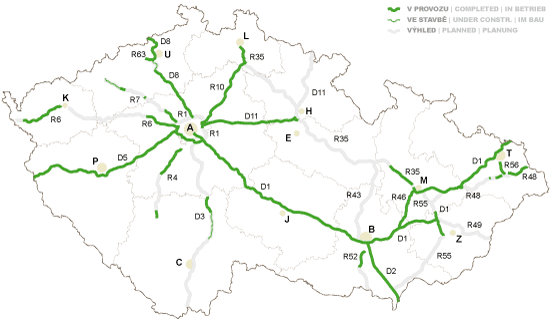
Czech Republic


The Czech Republic has one of the most developed motorway network in Central- and Eastern Europe. It's reached all the neighboring countries, and has two main hubs: Prague and Brno are the poles of the network.

 Motorways Czech Republic


Hungary


 Hungarian motorways


The 1400 km long Hungarian motorway system is the most wide-spread network in CEE. Hungary has 7 neighboring countries, and almost all these countries can be reached via motorway (Romania and Ukraine will be reached in 2015). TEN-T corridors from the north to south (Slovakia to Romania) and from the west to east (from Italy to Ukraine) are crossing each other in the region of Polgar Industrial Park.

Romania

 Romanian motorways


Romania, with its ~300 km motorway and its week quality road network, has a modest logistics potential. However, the large-scale motorway developments are in process, the total network (above) is planned to finish in 2016.

29 September 2011

ELECTROSITES IN BRNO (CZECH REPUBLIC)

Brno, the center of the historical Moravian region, is the second largest city of the Czech Republic crown lagging behind Prague with a population of 371 399 inhabitants as release from the statistics of 31.12.2009. From the past, the city has been a hub of renowned manufacturing industries and throughout the years, its stake in the industrial manufacturing sector has become bigger as it is now compare to Czech Republic as a whole, the second city which receive most foreign direct investment.

Transportation system and facilities

There is an integrated transport system in operation in the Moravian region where Brno is the urban center and the city can be access through a host of ways. From Its Brno-Turany international airport, there are everyday flights connecting other major cities in Europe like Moscow, London, Milan. By car, the city is the crossroad of motorways linking Vienna, Prague and many others Countries.

Industrial parks and Companies operating in the city

Among multinational companies headquartered in Brno, the more important are: IBM, ABB, FEI, Honeywell, ZETOR TRACTORS, USU RED HAT, Infosys BPO, OHL ŽS, Siemens Industry , CTP Invest, Vodafone, Telefónica, O2 Czech Republic, Bosch Rexroth, Symbol Technologies Czech Republic / Motorola, Andrew, AVG Technologies CZ, CB&I Lummus, Veletrhy Brno, Daikin Device. All these companies are located in two main industrial parks namely the Brno Industrial Zone Cernovice Terrace and the Czech Technology Park. The Cernovice terrace is a flat surface with an area of 179 ha suitable to host projects ranging from processing industry to specific fields like the strategic services and technological centers. The field of the processing industry would mainly include the branches such as aviation, astronautics, transportation means, computing techniques, information technology, electronics, telecommunications and radio communications, pharmacy, biotechnology and medical instruments. An estimate of the number of employed people in Brno is about 241152(according to the planning and development department 2007) and more than 20% of them are employed in the industry sector with half working in firms concentrated in the two manufacturing sites. These figures of employment rate are similar to others well developed cities in Europe and is one of the best in Czech Republic.

In term of innovation and entrepreneurial activities, it is important to precise that Brno possesses a good ranking in science and research thanks to their old industrial tradition and culture, but also to a good education system made of Institutes of research, academies and universities of science which are supported by Deemed professors and teaching staffs which provide qualified trained workforce to sustain the prosperity and the reputation of the city. Also, the existence of Innovative entrepreneurial incubator to facilitate and headquarter new firm start-up in the area of mature technologies are as many signs showing the determination of Brno to be one of the most successful cities in term of industry.

Sources:

http://www.invest-in-czech.cz/en/zona/201.html

http://www.brno.cz/fileadmin/user_upload/Podnikatel/Business_prospekt/Business_prospect_Brno_2011_EN.pdf

http://www2.brno.cz/index.php?lan=en&nav01=112&nav02=1627&nav03=1634

08 September 2011

Overview of electronics manufacturing locations in Central- and Eastern Europe


Nagyobb térképre váltás


Before the economic crisis, Hungary, the Czech Republic, Poland and Slovakia had the 80% of Central and Eastern European electronics industry’s output. After the crisis some countries like Romania or Russia look more important, but the leading 4 countries keep their positions.


Czech Republic
source: CzechInvest


The leading locations in the Czech Republic are the capital city Prague and the 2nd largest city Brno http://www2.brno.cz/index.php?lan=en&nav01=112&nav02=1627&nav03=1634 in the South-Eastern part of the country. Both cities have strong technical education on secondary and university level. Electronics has a 20% share In Brno’s economic output, and its two business parks host companies like Acer, Honeywell or Siemens.

Hungary
source: ITD Hungary


Reed Electronics Research’ Yearbook of World Electronics Data 2009/2010 ranked Hungary as the nr.1 electronics producer in CEE, representing the 30% of the regional production. The traditional electronics cluster located West from Budapest, the Székesfehérvár-Tatabánya-Komárom triangle hosts companies like Nokia, SCI, Philips etc. An emerging location is the Hungarian Plain (“pusta”) East from Budapest, including companies like Samsung, Jabil, Electrolux. Electronics-focused business parks (e.g. Polgar Industrial Park http://www.pip.info.hu/) provide industry-oriented technical education, fast start-up and good logistic support.

Slovakia
source: Sario


Although Slovakia is not a big country (it has ~5 million inhabitants), this is one of the top automotive manufacturing locations of Europe. Beside automotive industry, electronics has strong presence in Slovakia’s Nitra Region (South-West) http://www.sario.sk/userfiles/file/Ensario/PZI/reg/nitra_region.pdf. Leading international companies are Samsung, Sony, Osram and Foxconn.

Poland
source: PAIZ

Poland is the largest economy in Central- and Eastern Europe. International electronics companies like Siemens, Alcatel, Jabil, Toshiba etc employ 30,000 people nationwide. The electronics industry is especially strong in the central regions of the country, the Warsaw-Lodz-Bydgoszcz triangle represents the main cluster. Specialised business parks like „Crystal Park” closed to Bydgoszcz http://www.bydgoszcz.eu/ provide electronics-oriented environment.