Showing posts with label poland. Show all posts

25 September 2012

Government grants in Eastern Europe to boost electronics manufacturing

Electronics manufacturing is a prefered, strategic industry in almost all Eastern European countries. It means, when you establish here a new manufacturing plant, you can expect more "good points" from governments, which concludes higher grants.

Generally we can say, Eastern European governments' threshold stimulus is around 10 million euros investment and approx. 100 new jobs in electronics industry, under these numbers you are a very small investor. Governments normally sign an agreement with investor, so receiving a government grant is a contractual connection between the company and the government. It means, you get some money, but you also have some obligations, e.g: for job creation money you have to employ your staff for 1-2 years - and when you could't, you have to pay back the grant.
The subsidizing process always starts at the governmental investment promotion agencies: the PAIZ in Poland, The HITA in Hungary, the CzeckInvest in the Czech Republic, the Sario in Slovakia, and the RomTradeInvest in Romania. Decision making about the government subsidy requires normally 1-3 months.
There are several dues you can apply for, here we overview the most important:

#1 Real Estate development subsidies
Fundamentally there are 2 types of property grants: a) transfer of industrial land at a discount (e.g: in the Czech Republic) and b) building subsidies (e.g: in Hungary). When you think about real estate grants, do not forget: real estate business is a particular profession, and real estate costs are approx. 10% only of the total investment - it's much easier to lease a property on a subsidized fee.

Case study: subsidized leasing in Polgar, Hungary Polgar Industrial Park, Hungary won an EU grant in 2012 for development of a new, 7,000sq.meter (75,000 sq.feet) manufacturing hall, available from Q4 2012. The grant provides a leasing fee discount for potential investors, and in the meantime they don't have to invest in a real estate.


#2 Machinery purchasing grant
Most countries do not separate the real estate and machinery grants - they simply subsidizes investments in "assets". The machinery can be the main "eligible cost" of investment projects, e.g in the Czech Republic, "a basic condition is a minimum investment in long-term tangible and intangible assets in the amount of CZK 50 million in Regions I, of which at least CZK 25 million must be invested in new machinery, and  CZK 100 million in Regions II, of which at least CZK 50 million must be invested in machinery, whereas at least half of the minimum investment amount must by financed with the investor’s own capital." (CzechInvest's brochure 2012) 

#3 Job creation and other HR-related subsidies
The G-spot of Eastern European governments is job creation, this is the magic word you should build on. Many countries simply provides a "head money" for each new job created. For example, if you invest 40 million Polish Zloty (approx. 10 million EUR) in Poland, AND create 250 new jobs in electronics, the Polish government will grant you 800-3900 EUR per new jobs. The final job creation grant in Poland depends on the number of new jobs created, the percentage of employees with higher education, location, attractiveness of the products on the international markets etc. Other governments subsidize also smaller costs (e.g: employees' commuting cost in Hungary, training costs in many countries etc), but these are the typical schemes.

#4 Tax relieves
Eastern European governments are a bit shy when its about tax relieves. Before EU accession, most government provided large scale corporate income tax relieves, but the European Union doesn't like it indeed. However, most of the governments found smart, EU-compatible solutions for tax relieves. For example, the Hungarian government provides "development tax allowance", with the following scheme:
  • Amount of subsidy: exemption for 80% of the corporate tax payable for 10 years following installation. Up to HUF 500 M turnover the corporate tax rate is 10%, above HUF 500 M the tax rate is 19%.
  • Conditions: investment volume min. HUF 3 B (EUR 11.3 M), min. 150 new jobs OR HUF 1 B (EUR 3.7 M) investment volume and 75 new jobs in preferred regions
  • Application: depending on investment volume request or application needs to be submitted
  • Provider of incentive: Ministry for National Economy

#5 Cash grants
In the love packages of Eastern European governments there is two types of cash. All the grants above have specific goals, preferences, and obligations (e.g: re-training grants have to spend for local trainings), but when you hear about "cash grants" it means in general: you get money (normally not more than 5% of total investment costs) as a bonus.

The European sandbox
Finally: the government grants ("state aid" in European jargon) are generally prohibited by European Commission (the "federal government of EU"), because government grants have a negative impact on internal market competition. However, there are some exceptions, when EU not prohibits but supports state aids: the underdeveloped regions of Eastern Europe can provide grants on this way. The understanding of EU state aid policy can help to make better investment decisions, so lets take a look at the following presentation:


14 June 2012

The best electronic logistic hubs in Eastern Europe

Electronics manufacturing requires a strong logistic support, to organize the supply chain as cost-effective as possible. The Eastern European electronics industry is served from some matured and some emerging hubs.

Hungary

 M0 Motorway, Hungary

Budapest. The main logistic hub of Hungary (and maybe Eastern Europe) is Budapest. The M0 Motorway around the City is not a bypass only, but the location of several logistic parks and warehousing companies, developing ~3 million sq.meters (approx. 32 million sq.feet) industrial and logistic facilities. The US-based Prologis is the market-leader service provider in Hungary, and has almost 500k sq.meter (~5,3 million sq.feet) warehousing spaces in more logistic parks along the M0.

 Delivery times from Polgar

Polgar. The emerging hub of Polgar Industrial Park is located directly at the Polgar-exit of M3 motorway. The Polgar Industrial Park provides a north-south (Poland to Romania) and east-west (Ukraine to Western Europe) delivery routes, 3 borders (Slovakia, Ukraine, Romania) can be reached in 90-120 minutes by truck. The Industrial Park of the Year has a logistic program, including 120k sq.meter (1.3 million sq.feet) industrial and logistic hall development for the next 5-10 years. Subsidized rental fees are under 3€/sq.meter/month (under 3.3€/sq.feet/year).
More electronics companies has located its logistics support to Polgar. Jabil Curcuit, the leading US-based EMS provider, has its hub and consignation storages in Polgar Industrial Park. The storages on 5k sq.m support the manufacturing units in Ukraine and Hungary.

Poland


Poland's logistics map 2012


The polish logistic market is devided in 3 parts: the Sector I is the City of Warsaw, Sector II are the logistics parks around Warsaw, and Sector III are the logistic locations outside Warsaw. Although the Warsaw-sectors with ~2,5 million sq.meters are the largest logistics sites of Poland, the electronics industry are supported mainly from smaller hubs, like Lodz, Poznan, Krakow and Wroclaw. Average rental fees are between 3-3.5 €/sq.meter/month.

Lodz. Lodz is located in the cross-road of north-east A1 motorway and the east-west A2 motorway, in the Lodz-Poznan-Bydgoszcz electronic manufacturing triangle. More logistics-focused facilities provides A-class warehouses for electronics industry on 1 million sq.meters. The Goodman Lodz Logistic Centre has 27k sq.m total size, and the Logistic City in Piotrkow (Lodz Metro Area, closed to Lodz International Airport) with its 450k sq.m is one of the largest facility in Poland.
Wroclaw. Wroclaw (or its old German name: Breslau) is located in the South-Western corner of Poland, called 'Silesia', at the A4 motorway. It is a well known manufacturing centre with electronics companies such as Whirlpool, LG Philips, Siemens and many others. One of the leading service provider is Panattoni Logistics Park.

Czech Republic

 Czech logistic market 2012

Just like the Czech electronics industry, the electronics logistics is focused in two hubs: the capital city Prague and the 2nd largest city, Brno. These cities have strong transportation connections, developed industrial/logistics real estate markets and supportive authorithies.

Prague. The logistic centres around Prague are available for 2.5-4.5€/sq.meter/month (2.8-5€/sq.feet/year) rental fees. The Airport Logistic Park has a 56,000 sqm hall development in the surrounding of Prague International Airport.
Brno. Brno, the second largest city of the country is also the centre of electronics manufacturing industry, representing companies like Acer, Honeywell or Siemens. The city provides good infrastructure, strong technical education - and at last but not least an excellent logistic support. The CEE market leader Prologis will launch soon a brand new development called Prologis Logistic Park Brno on 90,000 sq.meter


16 April 2012

Motorway networks in Central- and Eastern Europe

Developing infrastructure makes Central- and Eastern Europe more attractive location than other emerging countries of the world.


 EU motorways 2011

The European Union has a vision about the cross-European transportation, called Trans-European Transport Network (TEN-T). The goal of TEN-T developments (funded by EU) is to make the EU internal market more competitive and to speed up the market access. The developments of member states fit into this framework, including the low-cost CEE Region.

Poland


The Polish motorway system is traditionally underdeveloped compared to other CEE countries. The European Football Championship 2012 will change dramaticly this picture, in 2015 there will be complete east-west and north-south motorway corridors in Poland.
The current develepments are focusing on Warsaw-Berlin motorway, involving Chinese companies, as this short video shows:


Slovakia


The most important one of the three Slovakian motorways is called D1 Motorway, starting from the capital city Bratislava, and directing Eastern Slovakia and Ukraine. Some part of this motorway is under construction, the Ukrainian border is planned to reach in 2020.

 Motorways Slovakia


Czech Republic


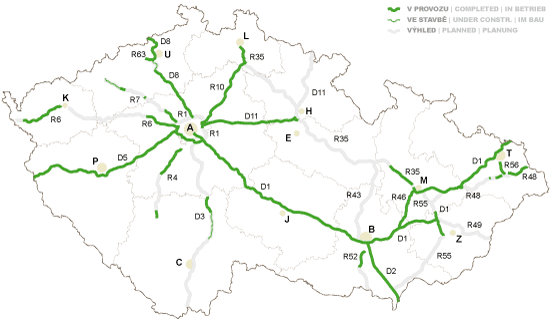
The Czech Republic has one of the most developed motorway network in Central- and Eastern Europe. It's reached all the neighboring countries, and has two main hubs: Prague and Brno are the poles of the network.

 Motorways Czech Republic


Hungary


 Hungarian motorways


The 1400 km long Hungarian motorway system is the most wide-spread network in CEE. Hungary has 7 neighboring countries, and almost all these countries can be reached via motorway (Romania and Ukraine will be reached in 2015). TEN-T corridors from the north to south (Slovakia to Romania) and from the west to east (from Italy to Ukraine) are crossing each other in the region of Polgar Industrial Park.

Romania

 Romanian motorways


Romania, with its ~300 km motorway and its week quality road network, has a modest logistics potential. However, the large-scale motorway developments are in process, the total network (above) is planned to finish in 2016.

13 October 2011

Bydgoszcz and its industrial park

Bydgoszcz is one of the most important cultural cities situated in the northern region of Poland. Renowned for its stylish landmarks and candidate for the 2016 European most cultural city, its urban area population curve has an outstanding growth rising from 104000 in 1925 to 358029 in 2009. Considered as one of the most attractive place in Poland, the city welcomes an increasing number of tourists coming from all over the world to see its unique Landscape and to gain some insight of jazz and contemporary classical music but also for its permanent exhibition of art nouveaux and its big concert hall marked as one of the best in Europe as regard to sound quality. In recent years, the city has known a strong economy growth, which is a result of a combination of many factors in presence like a well trained and qualified work force from diverse strain and culture of the society. The existence of first class university of life science and research, good infrastructure and well designed public transportation system

Business overview of Bydgoszcz

Classified as the 8th largest city in Poland, Bydgoszcz is the capital of the Kuyavia and the pomerania region and benefits from the establishment of well known multinational companies as well as medium sized companies. Among big corporations, we count proiprzem SA, Zachem SA ciech Chemical Group, Zespol Elektrocieplowni Bygoszcz SA, Alcatel-Lucent with most of them located in the Bydgoszcz industrial park. The city also provides banking and insurance services with a network of more than 38 banks and 37 insurance companies in operation downtown. The city gains more and more credibility as from the 2008 rating from Fitch rating agency, the city ranking has shifted forward from BBB stable forecast to BBB stable estimate.

Bydgoszcz industrial park

Bydgoszcz industrial park, covering an area of 208 ha is considered as one of the biggest in Poland. It is managed by a state owned entity BPPT which aim is to promote entrepreneurial activities, fostering the development of employment and make national as well as foreign company successful. Despite the fact that Bydgoszcz industrial park is one of the newest of the country as the first license have been drawn on December 21st 2004, the site count nowadays more than 41 businesses which employ approximately 500 workers. All those firms located in the district enjoy the support of Authorities and the BPPT in the way of transfer of technologies, consulting, assistance in the business settlement, consultancy, tax cut for new innovative companies, good environment for businesses etc…

Transportation system and facilities

Since the launching of the park in 2004, development projects supported by the European regional development funds are carried out in order to improve the capacity of the site and to modernize the existing one. Those projects include the improvement of a new road with lighting pavement and building of sewage system connecting the park with the city center. It is also worth noting the river connection between places in the city which provides possibilities to workers and clients to get to the park using a boat network. Concerning the railway tramway and buses network, there is as many possibilities to choose from if we want to go to the industrial site, Also the Bydgoszcz international airport is just at 3km away from the manufacturing sites.

CLICK TO ENLARGE


Source: http://en.wikipedia.org/wiki/Bydgoszcz

http://www.paiz.gov.pl/investment_support/industrial_and_technology_parks/bydgoszcz

http://www.bydgoszcz.eu/miasto/aktualnosci/news-archeive-2010-april-june/Inwestycja_w_BPP_rozpocz_ta.aspx


08 September 2011

Overview of electronics manufacturing locations in Central- and Eastern Europe


Nagyobb térképre váltás


Before the economic crisis, Hungary, the Czech Republic, Poland and Slovakia had the 80% of Central and Eastern European electronics industry’s output. After the crisis some countries like Romania or Russia look more important, but the leading 4 countries keep their positions.


Czech Republic
source: CzechInvest


The leading locations in the Czech Republic are the capital city Prague and the 2nd largest city Brno http://www2.brno.cz/index.php?lan=en&nav01=112&nav02=1627&nav03=1634 in the South-Eastern part of the country. Both cities have strong technical education on secondary and university level. Electronics has a 20% share In Brno’s economic output, and its two business parks host companies like Acer, Honeywell or Siemens.

Hungary
source: ITD Hungary


Reed Electronics Research’ Yearbook of World Electronics Data 2009/2010 ranked Hungary as the nr.1 electronics producer in CEE, representing the 30% of the regional production. The traditional electronics cluster located West from Budapest, the Székesfehérvár-Tatabánya-Komárom triangle hosts companies like Nokia, SCI, Philips etc. An emerging location is the Hungarian Plain (“pusta”) East from Budapest, including companies like Samsung, Jabil, Electrolux. Electronics-focused business parks (e.g. Polgar Industrial Park http://www.pip.info.hu/) provide industry-oriented technical education, fast start-up and good logistic support.

Slovakia
source: Sario


Although Slovakia is not a big country (it has ~5 million inhabitants), this is one of the top automotive manufacturing locations of Europe. Beside automotive industry, electronics has strong presence in Slovakia’s Nitra Region (South-West) http://www.sario.sk/userfiles/file/Ensario/PZI/reg/nitra_region.pdf. Leading international companies are Samsung, Sony, Osram and Foxconn.

Poland
source: PAIZ

Poland is the largest economy in Central- and Eastern Europe. International electronics companies like Siemens, Alcatel, Jabil, Toshiba etc employ 30,000 people nationwide. The electronics industry is especially strong in the central regions of the country, the Warsaw-Lodz-Bydgoszcz triangle represents the main cluster. Specialised business parks like „Crystal Park” closed to Bydgoszcz http://www.bydgoszcz.eu/ provide electronics-oriented environment.