The leading electronics manufacturing company, Jabil Circuit employs almost 9,000 people in Hungary, the main parts of your Blackberry probably was made here. This blog post provides an insight into the company's operation in Hungary.
Jabil Tiszaújváros
Jabil Tiszaujvaros
Jabil Hungary, with 1 billion € turnover, is a top100 company in the country. Its Tiszaujvaros plant (Eastern Hungary) is one of the largest manufacturing facility of the company in Europe. Almost 8,000 people work for Jabil in the little town, which has a population about 16,000 - Jabil recruits workers in 50 kms radius. The small, but highly industrialized Tiszaujvaros also has some large chemical companies, e.g: TVK, the leading plastic raw material producer in Eastern Europe. Jabil obviously calculates on the Tiszaujvaros plant in the future: there are permanent developments also in the crisis, in 2011 almost 700 new jobs were created in the facility.
In 2011, the company rented a new logistics center in the neighbouring Polgar Industrial Park, which provides logistic support for Tiszaujvaros and the Ukrainian production facilities.
Jabil Szombathely
Jabil Szombathely
The company Szombathely facility provides aftermarket services for leading electronics brands (we don't know the clients list, Jabil manages it very confidentially). Szombathely is a little town in Western Hungary (it could be known from James Joyce' Ulysses). The Jabil employs here 1000+ staff. The facility were opened in 2003, and at the beginning of the crisis there were some press news about the shutdown of the Szombathely plant, and relocation of aftermarket services to Tiszaujvaros. Finally, the Szombathely plant escaped, and in 2012 newer jobs were created during the consolidation of Szombathely activities.
Finally, let's see a short overview about the company 2013 plans:
Eastern Hungary has 95 industrial parks (link), more awarded by the “Industrial Park of the Year” award. It’s more, than the number of industrial parks in Poland.
#3: Focused education
Eastern Hungary has +53% more university and collage students than Western Hungary. Eastern Hungary has 2 electronics university faculties, and the electronics-related vocational education is also strong.
#4: Large labour supply
The number of unemployed people of Eastern Hungary is 300k, which is equal to entire Slovakia.
#5: Governmental incentives are focusing on Eastern Hungary
The goal of governmental incentives is to orient foreign direct investments into underdeveloped regions with high unemployment. Eastern Hungary is among the most intensively (potentially 50%) subsidized regions of the EU.
#6: Award winning location
Eastern Hungary is one of the most awarded Central- and Eastern European locations by Financial Times’ fDi Magazine: 2 regions and 2 cities of Eastern Hungary was ranked for the top doing business locations of Europe.
Company insight
Finally, the following video provides a short insight to the life of National Instuments Hungary, one of the leading Eastern Hungarian electronics companies.
The future in Transportation infrastructure
(logistic) between China and East Europe
Transportation infrastructure, or we can
simply say logistics.
If we get down to building the bright
future for East Europe, then investment definitely comes first. However
precondition and base has to be met. This is exactly the part of logistics.
For better understanding, let us see the
general condition of East Europe:
There are 18 countries (except BY, UA and
RU) on this land and population with 250 million (except RU).
The transportation volume statistic in each
country (per years) :
Clear
views on transportation in East Europe
Airborne in East Europe:
1.Speed fast (lower the risk in
transit, suitable for valuables and precise instrument)
2.No geographical restriction
3.Few airport comparing to West
Europe (it takes time to build airport, also with high cost, thus, just a few
East European countries use air transport)
Waterborne (shipping) in East Europe:
1.The overall level of shipping
in East Europe is low
2.Out-dated and backward in
management system
3.Improper fleet construction
4.Lack support of fund
5.Less developed in private
shipping industry
Not competitive in the international
shipping market, also the needs of shipping cannot be met.
Just a few East Europe countries have
waterborne transportation.
Most of the East European countries are far
from port, therefore it falls behind.
Road transportation in East Europe:
1.High flexibility and
adaptability (much much frequently use then railway and shipping)
2.“door to door” can be realized
(directly sent to different farms and industries in different district)
3.Low scale of volume, high cost
4.Low security index,
environmental unfriendly
5.Backward in road network (low speed
of improvement in transportation infrastructure)
Railway in East Europe:
The main type of transportation from 1990
1.High speed
2.Low land occupation (comparing
to other types)
3.Environmental friendly (the
electric locomotive basically has no toxic gas)
4.High security index (relative
reliable)
5.Low cost in transportation
6.High scale of volume
7.High resistance to changeable weather
conditions
8.Improper allocating in cargo
capacity and infrastructure, high cost in using infrastructure
9.Relative worse relationship between
the state, the manager of infrastructure and transportation company
Let’s see the transportation infrastructure
from the view of Hungary.
First of all, we cannot ignore the significant
meaning in logistics as it is the heart of Europe. Since it became part of the 455
million populated European Union in May, 2004. All investors and foreign
companies can see are new opportunities in their eyes. Logistics and
transportation services became one of the 7 largest industries in Hungarian
development system.
As the main part of developing Hungary, the
Hungarians are bending themselves in gradually becoming the logistic centre of CEE
countries.
The main
suppliers in logistics
The logistics market in Hungary scales $1
billion and it is keep developing in a relative high speed.
After 8 year the scale will doubled or
tripled.
Nowadays, logistic takes the main force in
Hungarian enterprises, the market share of foreign companies only takes 13% from
more than 41 countries even if the foreign companies continuously entering the
Hungarian logistic market. The main FDI are coming from the neighbor countries
like Netherland, Germany and Austria.
Rynart
Group, Netherland.
It has cooperated with Hungarian
enterprises since 1980s in warehousing customs clearance, domestic distribution
network etc. the subsidiary called Rynart Transport Hungary Kft. In Hungary has
becoming one of the bellwether in Hungarian logistics service supplier.
REWICO, Germany.
Who entered Hungary since 1996, purchased
the share of partners in Hungary, it has further plan in taking over other
logistic companies there, which aims to be one of the top 10 logistic
companies.
Also there are other logistic companies
like DHL, Frans Maas, Kuehne&Nagel, NYK Logistics, Rudolph Logistik, UPS
and Wincanton etc.
We cannot
ignore the sponsorship from government is another main incentive:
The targets in building logistics market
from 2007 to 2015, Hungary.
1.Build the central network of
logistics. Environmental friendly and modernization.
2.Develop infrastructure of the ports
(Gyor-Gonyu, Budapest, Dunaujvaros and Baja) along the Danube.
3.Develop the international
airport in separate areas (Budapest, Debrecen and Sarmellek).
4.Introduce the Intelligent
Transport System to improve the transportation efficiency.
From
the view of Chinese investors and responders in East Europe
On the one side, China lays the stresses on
investing CEE (16 countries)
On the other side, the CEE countries pay
more attention on what China going to do next and the trend of how Chinese
economy will be.
There are recent proofs supporting the
situation we face now, where we see China and Eastern Europe are waving hands
to each other.
In
terms of related legal bases
It is well-known that the Shanghai EXPO was
holding in the summer of 2010, not surprised a public lecture or training
organized by China-EU School of Law and the China University of Political
Science and Law was holding in the European Union pavilion on 26th
of July, 2010. The main subject to this lecture is the potential opportunities
and future achievements in directly investing in Eastern Europe from China. This
training involves the movers and shakers from different universities in
Hungary. Such as Andras Kisfaludi and Attila Menyhard from Eotvos Lorand
University, Tibor Tajti from China-EU University. The training shared the
successful achievements (mostly in Hungary, Poland and Latvia) and the
companies (eg: Huawei, Lenovo, Kinglong and TBV), clarified the legal parts
which directly influence FDI from China especially the applied new laws, in
discussing the best way for investing Eastern Europe under the advanced
investment model. Where we can say this is specially designed for Chinese
potential investors and the waited opportunities in Eastern Europe.
In
terms of related political bases
As Hungary is the heart of Europe, it makes
sense that FDI starts or sets Hungary as the main target. Where we can see from
the official conference between Chinese and Hungarian President as the
following video, which was holding just in the year 2011.
Right after the year of 2011, the Chinese
government has made several actions in this following year. New rules, new
investors, new missions and new opportunities. That’s their job.
The most obvious is on 26th of
April, 2012, Wen Jiabao, President of China had a meeting with all the 16
countries presidents in Warsaw, Poland.
In terms
of the investors’ interests bases
The so called “2012 International Economic and
Trade Fair for Central and Eastern European countries” was holding in Beijing
CBD on 18th, September, 2012. The Chaoyang District has been the
first one who signed the Strategic Alliance Agreement with 16 CEE countries as
the No.1 district concerning foreign affairs in China. From the date the
agreement approved, all the Chinese competitive and strong enterprises will
have the priority to enter and invest in the 16 countries (eg: Slovenia, Bosnia
and Poland). The field of investment involves some important sectors like telecommunication
service, transportation infrastructure and financial sector.
In terms
of the financial bases
Wen Jiabao, President of China announced on
26th of April, 2012, the meeting with all the 16 countries presidents
in Warsaw, Poland. China will provide a special credit limits $10 billion with
preferential rules for supporting the cooperation in the field of
infrastructure, high technology and green economy etc. initiates the mutual
fund under the collaboration.
Then we are looking forward to the bright
future in East Europe and be patient to see what will happen.
Electronics manufacturing is a prefered, strategic industry in almost all Eastern European countries. It means, when you establish here a new manufacturing plant, you can expect more "good points" from governments, which concludes higher grants.
Generally we can say, Eastern European governments' threshold stimulus is around 10 million euros investment and approx. 100 new jobs in electronics industry, under these numbers you are a very small investor. Governments normally sign an agreement with investor, so receiving a government grant is a contractual connection between the company and the government. It means, you get some money, but you also have some obligations, e.g: for job creation money you have to employ your staff for 1-2 years - and when you could't, you have to pay back the grant.
The subsidizing process always starts at the governmental investment promotion agencies: the PAIZ in Poland, The HITA in Hungary, the CzeckInvest in the Czech Republic, the Sario in Slovakia, and the RomTradeInvest in Romania. Decision making about the government subsidy requires normally 1-3 months.
There are several dues you can apply for, here we overview the most important:
#1 Real Estate development subsidies
Fundamentally there are 2 types of property grants: a) transfer of industrial land at a discount (e.g: in the Czech Republic) and b) building subsidies (e.g: in Hungary). When you think about real estate grants, do not forget: real estate business is a particular profession, and real estate costs are approx. 10% only of the total investment - it's much easier to lease a property on a subsidized fee.
Case study: subsidized leasing in Polgar, Hungary
Polgar Industrial Park, Hungary won an EU grant in 2012 for development of a new, 7,000sq.meter (75,000 sq.feet) manufacturing hall, available from Q4 2012. The grant provides a leasing fee discount for potential investors, and in the meantime they don't have to invest in a real estate.
#2 Machinery purchasing grant
Most countries do not separate the real estate and machinery grants - they simply subsidizes investments in "assets". The machinery can be the main "eligible cost" of investment projects, e.g in the Czech Republic, "a basic condition is a minimum investment in long-term tangible and intangible assets in the amount of CZK 50 million in Regions I, of which at least CZK 25 million must be invested in new machinery, and CZK 100 million in Regions II, of which at least CZK 50 million must be invested in machinery, whereas at least half of the minimum investment amount must by financed with the investor’s own capital." (CzechInvest's brochure 2012)
#3 Job creation and other HR-related subsidies
The G-spot of Eastern European governments is job creation, this is the magic word you should build on. Many countries simply provides a "head money" for each new job created. For example, if you invest 40 million Polish Zloty (approx. 10 million EUR) in Poland, AND create 250 new jobs in electronics, the Polish government will grant you 800-3900 EUR per new jobs. The final job creation grant in Poland depends on the number of new jobs created, the percentage of employees with higher education, location, attractiveness of the products on the international markets etc. Other governments subsidize also smaller costs (e.g: employees' commuting cost in Hungary, training costs in many countries etc), but these are the typical schemes.
#4 Tax relieves
Eastern European governments are a bit shy when its about tax relieves. Before EU accession, most government provided large scale corporate income tax relieves, but the European Union doesn't like it indeed. However, most of the governments found smart, EU-compatible solutions for tax relieves. For example, the Hungarian government provides "development tax allowance", with the following scheme:
Amount of subsidy: exemption for 80% of the corporate tax payable for 10 years following installation. Up to HUF 500 M turnover the corporate tax rate is 10%, above HUF 500 M the tax rate is 19%.
Conditions: investment volume min. HUF 3 B (EUR 11.3 M), min. 150 new jobs OR HUF 1 B (EUR 3.7 M) investment volume and 75 new jobs in preferred regions
Application: depending on investment volume request or application needs to be submitted
Provider of incentive: Ministry for National Economy
#5 Cash grants
In the love packages of Eastern European governments there is two types of cash. All the grants above have specific goals, preferences, and obligations (e.g: re-training grants have to spend for local trainings), but when you hear about "cash grants" it means in general: you get money (normally not more than 5% of total investment costs) as a bonus.
The European sandbox
Finally: the government grants ("state aid" in European jargon) are generally prohibited by European Commission (the "federal government of EU"), because government grants have a negative impact on internal market competition. However, there are some exceptions, when EU not prohibits but supports state aids: the underdeveloped regions of Eastern Europe can provide grants on this way. The understanding of EU state aid policy can help to make better investment decisions, so lets take a look at the following presentation:
There are not too many aircraft industry in
CEE countries, but in some typical country it has relative advanced technology
in manufacturing aircraft.
Czech Republic:
It mainly provides civil aircraft, light
sport aircraft and private aircraft, the average annual production is 550 light
aircrafts and sport aircraft also 1400 aircrews. It holds the whole
intellectual property, 80%of its production are exported. It is the second
largest aircraft producing country which after Germany. Recently, the new
aircraft such as light fighter, sport airplane, glider and air traffic control
system has become the main production in Czech aircraft industry. Nowadays,
there are 7 main aircraft manufacturers, the biggest two are Aero Vodochody and
Evektor-Aerotechnik.
Poland:
Poland starts its aircraft industry since
the beginning of 20 century. It has high technology in aircraft repairing and
producing. There are around 55 enterprises of aircraft producing in Poland,
which mainly exports to America, Venezuela, Italy, Greece, Canada, Spain, Germany,
Korea, Indonesia, Vietnam and Iraq. For the most important is the education
resources there, for example they have a university called Rzeszow University
of Technology, they set there a high-tech center. On the other hand, Poland has
potential in repairing and maintaining. Till 2006, there are 28 enterprises in
Poland have got the Part-145 aircraft repairing certificate.
Slovakia:
In Slovakia, it has a solid foundation in
mechanical manufacturing industry, the most advanced technology is DV-2 engine
which is widely used in trainer aircraft.
No.5:
Viniculture
You can find pretty nice weather and
comfortable climate there in CEE which is good for producing grape wine also
they have long history in viniculture. Romania, Bulgaria, Hungary, Czech,
Serbia and Macedonia are all the famous wine country.
Hungary:
Hungary has long history in producing grape
wine, the variety and quality of grapes are quite high in Hungary. The famous
grape wine as we can count are Bikaver, Tokajiaszu, Ekfrakos,Liszt’s favorite Kdarka
and so on. For the Tokajiaszu is the well known world sweet wine. The royal France
call it the king of the wine.
Bulgaria:
Bulgaria is pretty rich in producing
grapes, as one of the top 15 wine producing countries, wine-making industry has
become an important traditional industry. The Vinaria exhibition of Plovdov will
take place every year in Bulgaria, it is the largest exhibition in CEE
countries. The president of Bulgaria says wine is the image of its country and
it is the main feature of its national economy. There are 255 enterprises have
registered in the national grape and wince association. The main export markets
are Russia, Poland, Germany, UK and Czech.
Romania:
Romania is one of the biggest world wine
producing countries. They call themselves “the land of wont”. It is well-known
by its quality and designing, especially Feteasca regala and Recas are the most
favorable wine. The main manufactures are Vincon in Varabcea, Murfatlar,
Halewood Group.
Hope you will know more about CEE countries
after read this article, and does your investment made the best choice?
As we know the Central East Europe contains
Poland, Hungary, Czech, Slovakia, Slovenia, Romania, Bulgaria, Serbia, Croatia,
Bosnia etc. 13 countries with total area 117 square kilometers, population over
120 million which has total GDP around 0.9 billion dollar, total foreign trade
0.89 billion dollar. This area has pretty strong foundation in various
industries such as motor industry, generating equipments, mining as well as
aircraft manufacturing, shipbuilding, even on biotechnology, pharmacy and also
has advantage in producing agricultural products and grape wine. All of these industries experienced a rapid
development since 7 of them (Poland, Hungary, Czech...) entered the EU, and
becoming more competitive.
From now on, let me specifying some
dominant industries and put them into these main CEE countries which has dominant
in each industry as well.
No.1:
Motor industry
Czech Republic:
Since the data shows motor industry already
has over 100 years history in Czech Republic, it is the most important
department in processing industry there. It also takes 20% in its economy which
makes car being the major export product and the export has topped 9% of the
total export in Czech. Škoda is the main place they produce cars, its annual
output has reached 500,000 cars and selling to all over the world, obviously it
became the bellwether in its field. Nowadays, the first car “Octavia” which
corporate with Shanghai Volkswagen was coming to the market. Not only in small
cars but coach has taken a competitive position in West European market. We can
see the biggest coach producing factory is Karosa there.
In addition, more than 40 car manufacture
out of the top 100 has set the branches in Czech.
Poland:
Since 1990, the motor industry has
developed well in Poland by absorbing foreign investment. The output of cars
and export continuously increasing, the product quality and level of skills has
improved as well, Poland became the No.8 car-making country in Europe, just
after Russia, Czech and Sweden. The three biggest manufacturers are Fiat, Opel
and Volkswagen which are well-known by all of us. The high criteria for fitting
technology and various devices to choose give incentives for famous company
investing there.
Slovakia:
Motor industry takes a pretty important
strategic position in Slovakia. Volkswagen AG is the most powerful enterprise
there, some well-known manufacturers like the PSA from France and the Kia from
Korea has also invest plants there. In 2006, these three manufacturers has
producing 295390 cars in total which occupies 28.4% of total industrial output.
Except investing in plants, the fittings became attractive too, the investment
of fitting keeps climbing. The worldMarkets Research Centre(WMRC) says Slovakia
and India, Thailand, Iran as well as Czech are the most attractive countries of
motor industry, they will be the center for developing new cars in the near
future.
Hungary:
Motor industry is a traditional industry in
Hungary. Since 90s of 20th century, car and its fitting industry got
rapid development and became the main pillar of Hungarian motor industry, the
foreign investment takes a huge portion. In 1992, the Suzuki from Japan set the
first manufacturer in Hungary, then Opel Germany in 1994, Audi in 1997. Audi
started car assembling since 1998 but not just producing the engine. The
General Motor is producing automobile gearbox for all European countries as
well as exporting to China.
Romania:
The industrial base in Romania is very
well. It mainly has Dacia, Oman, Roman Corporation. Dacia started producing
Renault(Romania) and named it as DACIA 1300, this car kept its production
around 35 years. In 1999, Renault purchased Dacia, and then produced SuperNova
and Solenza in 2000 and 2003. In 2004, Dacia offered an economic car which
called Logan, it was acclaimed by the market. However the Roman Corporation stopped
its production under a fierce competition in the market, now they are looking
for the substitution.
All of these helped CEE countries in
increasing more working position.
No.2:
Environmental Protection Technology and Equipment:
In CEE countries for example Hungary, Czech
and Slovakia, they have pretty high level in dealing with industrial sewage,
waste disposal and microbiological treatment.
Here I mention the R-AN-D-N technology from Czech, which is widely
used in different area. Also the USBF technology to processing the sewage, it
has applied in so many countries such as USA, Germany, Italy, Canada, Spain and
so on.
No.3:
Pharmacy
Hungary:
It has more than one year history and it
became one of the most competitive industry in Hungary.
There are more than 20 pharmaceutical
factory, The biggest one IS Richter Gedeon. This company has over 100 products
and 140 kind of preparation. This company has its own R&D department and
producing medicine by their own, these products can apply for all the
therapeutic area. Two third of its products has sent to over 100 countries.
Egis pharmaceutical factory is the second
biggest one in Hungary which has a long history.
Chinoin ranks the third one, it exporting
its products to more than 80 countries.
See more please check the following article(part2).
Electronics manufacturing requires a strong logistic support, to organize the supply chain as cost-effective as possible. The Eastern European electronics industry is served from some matured and some emerging hubs.
Hungary
M0 Motorway, Hungary
Budapest. The main logistic hub of Hungary (and maybe Eastern Europe) is Budapest. The M0 Motorway around the City is not a bypass only, but the location of several logistic parks and warehousing companies, developing ~3 million sq.meters (approx. 32 million sq.feet) industrial and logistic facilities. The US-based Prologis is the market-leader service provider in Hungary, and has almost 500k sq.meter (~5,3 million sq.feet) warehousing spaces in more logistic parks along the M0.
Delivery times from Polgar
Polgar. The emerging hub of Polgar Industrial Park is located directly at the Polgar-exit of M3 motorway. The Polgar Industrial Park provides a north-south (Poland to Romania) and east-west (Ukraine to Western Europe) delivery routes, 3 borders (Slovakia, Ukraine, Romania) can be reached in 90-120 minutes by truck. The Industrial Park of the Year has a logistic program, including 120k sq.meter (1.3 million sq.feet) industrial and logistic hall development for the next 5-10 years. Subsidized rental fees are under 3€/sq.meter/month (under 3.3€/sq.feet/year).
More electronics companies has located its logistics support to Polgar. Jabil Curcuit, the leading US-based EMS provider, has its hub and consignation storages in Polgar Industrial Park. The storages on 5k sq.m support the manufacturing units in Ukraine and Hungary.
Poland
Poland's logistics map 2012
The polish logistic market is devided in 3 parts: the Sector I is the City of Warsaw, Sector II are the logistics parks around Warsaw, and Sector III are the logistic locations outside Warsaw. Although the Warsaw-sectors with ~2,5 million sq.meters are the largest logistics sites of Poland, the electronics industry are supported mainly from smaller hubs, like Lodz, Poznan, Krakow and Wroclaw. Average rental fees are between 3-3.5 €/sq.meter/month.
Lodz. Lodz is located in the cross-road of north-east A1 motorway and the east-west A2 motorway, in the Lodz-Poznan-Bydgoszcz electronic manufacturing triangle. More logistics-focused facilities provides A-class warehouses for electronics industry on 1 million sq.meters. The Goodman Lodz Logistic Centre has 27k sq.m total size, and the Logistic City in Piotrkow (Lodz Metro Area, closed to Lodz International Airport) with its 450k sq.m is one of the largest facility in Poland.
Wroclaw. Wroclaw (or its old German name: Breslau) is located in the South-Western corner of Poland, called 'Silesia', at the A4 motorway. It is a well known manufacturing centre with electronics companies such as Whirlpool, LG Philips, Siemens and many others. One of the leading service provider is Panattoni Logistics Park.
Prague. The logistic centres around Prague are available for 2.5-4.5€/sq.meter/month (2.8-5€/sq.feet/year) rental fees. The Airport Logistic Park has a 56,000 sqm hall development in the surrounding of Prague International Airport. Brno. Brno, the second largest city of the country is also the centre of electronics manufacturing industry, representing companies like Acer, Honeywell or Siemens. The city provides good infrastructure, strong technical education - and at last but not least an excellent logistic support. The CEE market leader Prologis will launch soon a brand new development called Prologis Logistic Park Brno on 90,000 sq.meter
Developing infrastructure makes Central- and Eastern Europe more attractive location than other emerging countries of the world.
EU motorways 2011
The European Union has a vision about the cross-European transportation, called Trans-European Transport Network (TEN-T). The goal of TEN-T developments (funded by EU) is to make the EU internal market more competitive and to speed up the market access. The developments of member states fit into this framework, including the low-cost CEE Region.
Poland
The Polish motorway system is traditionally underdeveloped compared to other CEE countries. The European Football Championship 2012 will change dramaticly this picture, in 2015 there will be complete east-west and north-south motorway corridors in Poland. The current develepments are focusing on Warsaw-Berlin motorway, involving Chinese companies, as this short video shows:
Slovakia
The most important one of the three Slovakian motorways is called D1 Motorway, starting from the capital city Bratislava, and directing Eastern Slovakia and Ukraine. Some part of this motorway is under construction, the Ukrainian border is planned to reach in 2020.
Motorways Slovakia
Czech Republic
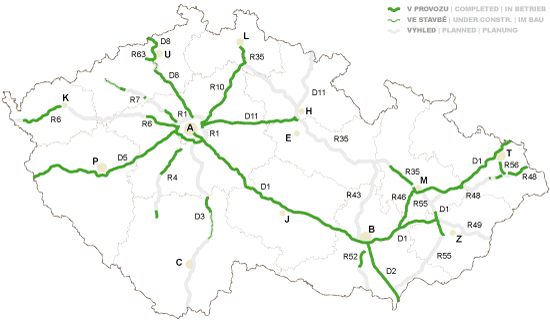
The Czech Republic has one of the most developed motorway network in Central- and Eastern Europe. It's reached all the neighboring countries, and has two main hubs: Prague and Brno are the poles of the network.
Motorways Czech Republic
Hungary
Hungarian motorways
The 1400 km long Hungarian motorway system is the most wide-spread network in CEE. Hungary has 7 neighboring countries, and almost all these countries can be reached via motorway (Romania and Ukraine will be reached in 2015). TEN-T corridors from the north to south (Slovakia to Romania) and from the west to east (from Italy to Ukraine) are crossing each other in the region of Polgar Industrial Park.
Romania
Romanian motorways
Romania, with its ~300 km motorway and its week quality road network, has a modest logistics potential. However, the large-scale motorway developments are in process, the total network (above) is planned to finish in 2016.
In recognition of the efforts exerted by the
industrial park and the local government in the field of investment promotion,
the Polgár Industrial Park won the Best Industrial Park award. The Hungarian Investment and Trade Agency (HITA)
bestowed the so-called Investor of the Year Award on companies that
extraordinarily contributed to the development of the Hungarian economy in 2011.
The award was vouchsafed in six categories in the Upper House of the Parliament
on 26 January 2012.
The Best Industrial Park award was
bestowed on the Polgár Industrial Park for its efforts exerted to promote
investments. In cooperation with the local government, Polgár-Invest Kft. (that
is the member of the InfoGroup real estate and property development corporate
group) in charge of operating the industrial park entered inter alia
investor-friendly measures into effect, such as the reform of the vocational
training in accordance with the investors’ demands or the prioritized licensing
and other administrative management of the settlers. By this award, the
operator of the industrial park was recognised as similarly as the local
government of the town of Polgár that collected the title of Investor-friendly
Local Government in 2009.
Jabil Circuit warehouse in Polgár Industrial Park
As a consequence of the close
cooperation of the privately owned operator and the local government, the
Polgár Industrial Park could welcome many new settlers in 2011. Having been
recognised for creating jobs, Jabil Circuit installed its 4,000 m2
business domicile here which satisfies the demands of its plants, each built in
Eastern Hungary and in Ukraine, and which renders full warehousing and customs
clearance services. As a newcomer logistics service provider, Toyota Tsusho
will perform the international logistics processes of one of the largest multinational
corporations manufacturing household appliances in its first, 6,000 m2
business domicile that is built in Hungary. Delta-Truck, which distributes Renault
trucks, purchased its industrial property here in 2011, and the Gyermely pasta
plant constructed its 2,000 m2 regional distribution centre
here.
Investors that require prompt plant
installation stand in the centre of the focused business development strategy
of InfoGroup that is in charge of developing the Polgár Industrial Park. The
company offers its self-developed light industrial and warehousing halls, which
can be installed just within 4 to 5 months, for these investors. The foundation
of the foregoing has been implemented by the stable bank financing background,
the erection licenses obtained in advance, and the project management know-how
that has a history of two decades.
Hungarian Investment Trade Agency and Investor of the Year Award Winners (AGCO, Jabil Circuit, Audi Motors Hungary, Bosch, Mylan and Polgár Industrial Park)
Being frequently accorded since 2004, the Investor of the Year Award was
conferred this year to recognise the remarkably performing companies during the
period of the economical global crisis. Mylan carried out the largest green
field investment of 2011 in the city of Komárom (EUR 60 million), Audi Hungária
Motor Kft., which was awarded in the previous years as well, implemented the
largest volume expansion by the expansion of its pressing plant in the city of
Győr (EUR 300 million). As regards creating new jobs, Jabil Circuit
Magyarország Kft. was proven the most effective with an increase of 670 in the
headcount of its corporate personnel. The Shared Service Center of the
agricultural machinery manufacturing AGCO established in Budapest and employing
corporate personnel of 170 acquired the title of the largest new regional
service centre, while the exemplary activity of Bosch conducted with
universities and research institutes was recognised in the field of R+D
cooperation.