03 May 2012

5 reasons to start electronics manufacturing in Eastern Slovakia


Slovakia is the 3rd most relevant electronics manufacturing country in Central- and Eastern Europe, achieving 60,000+ employees in 2012. Eastern Slovakia provides more benefits for newcomming electronics companies.


#1: Developed transportation infrastructure
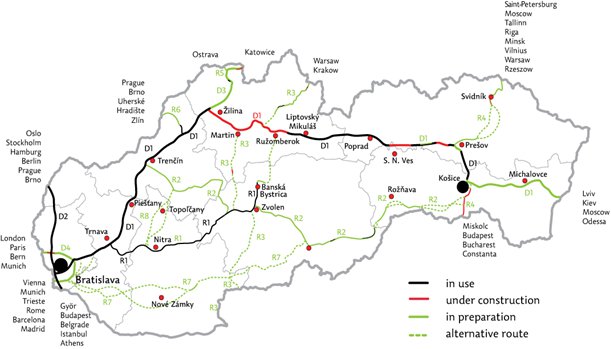
Eastern Slovakia can be reached via D1 motorway (and also via M3 motorway in Hungary).


The Kosice International Airport has daily flights to Vienna, Prague and Bratislava. The motorway access + the daily airflights to main hubs are a rare combo in the low-cost locations of CEE.

#2: Large labour supply

Eastern Slovakia has a proven track record in electronics industry, representing companies like Panasonic, BSH or Tesla (see the map), but not overloaded with competing electronics companies than Western Slovakia, Western Hungary or some Czech regions.
Eastern Slovakia has an unemployed rate over 18%, much higher than e.g. the Western Romanian electronics cluster has. It means low labour costs, low wage inflation and good HR costs projection opportunities.

#3: Focused education

There are over 40 secondary and vocational schools with specialisation on electrical engineering in Slovakia. Number of secondary school student in the field of electrical engineering and related studies is 25,000. And there are over 27,000 students (2,000 doctoral studies students) at 4 universities oriented towards electronics and electrical engineering industry. (source: Sario, 2011)

The Technical University of Kosice has 2,500 students on electronics and IT engineering, 1,000 students on manufacturing technologies, and the university also provides studies on mechanical engineering, aeronautics or economics.

#4: Full infrastructure real estate options


The Kechnec Industrial Zone is located south from Kosice, closed to the Hungarian border. The business park is one of the most successful facilities in Slovakia and Central- and Eastern Europe. The large (332 hectares/820 acres) business park has large scale infrastructure, good labour market conditions (between two metropolitan areas, Kosice and Miskolc, Hungary). Electronics companies like Magneti Marelli, IEE Sensing are running business in Kechnec.

ImmoPark Kosice belongs to the Austrian banking group Erste. The project with the total area of 60 hectares next to the Kosice Airport will offer over 250.000 sqm of lettable area. The halls were designed to fit any special requirements. The first phase will be available from Q3 2012.

#5: Governmental incentives are focusing on Eastern Slovakia

The Slovakian Act on Investment Aid defines the framwork of national incentives in Slovakia. The incentives are provided in the form of:
a) a subsidy for the acquisition of material assets and immaterial assets,
b) an income tax relief,
c) a contribution for created new jobs,
d) transfer of immovable property or exchange of immovable property at a price lower than a general asset value

The goal of governmental incentives is to orient foreign direct investments into underdeveloped regions with high unemployment. One of the main target area is Eastern Slovakia, so prepare for a pleasant surprise thinking about investing there.

-----
About Sario
The Slovak Investment and Trade Development Agency (SARIO) is a government-funded allowance organization that works under the supervision of the Ministry of Economy of the Slovak Republic. SARIO’s primary objective is to improve the standard of living of Slovak citizens by increasing employment and reducing regional disparities.

After the first international award for SARIO, the ‘European IPA Award‘ of 2003, the international prestige of foreign investment’ services delivered by the Slovak Investment and Trade Development Agency was recognized again in 2007 when SARIO won ‘Best European Investment Agency Award for High-Tech‘ at the World Investment Conference in La Baule (France).


Slovakia - Global Best to Invest 2010
by Site Selection Magazine 2011

16 April 2012

Motorway networks in Central- and Eastern Europe

Developing infrastructure makes Central- and Eastern Europe more attractive location than other emerging countries of the world.


 EU motorways 2011

The European Union has a vision about the cross-European transportation, called Trans-European Transport Network (TEN-T). The goal of TEN-T developments (funded by EU) is to make the EU internal market more competitive and to speed up the market access. The developments of member states fit into this framework, including the low-cost CEE Region.

Poland


The Polish motorway system is traditionally underdeveloped compared to other CEE countries. The European Football Championship 2012 will change dramaticly this picture, in 2015 there will be complete east-west and north-south motorway corridors in Poland.
The current develepments are focusing on Warsaw-Berlin motorway, involving Chinese companies, as this short video shows:


Slovakia


The most important one of the three Slovakian motorways is called D1 Motorway, starting from the capital city Bratislava, and directing Eastern Slovakia and Ukraine. Some part of this motorway is under construction, the Ukrainian border is planned to reach in 2020.

 Motorways Slovakia


Czech Republic


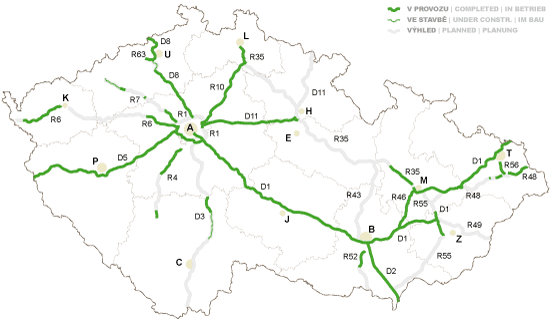
The Czech Republic has one of the most developed motorway network in Central- and Eastern Europe. It's reached all the neighboring countries, and has two main hubs: Prague and Brno are the poles of the network.

 Motorways Czech Republic


Hungary


 Hungarian motorways


The 1400 km long Hungarian motorway system is the most wide-spread network in CEE. Hungary has 7 neighboring countries, and almost all these countries can be reached via motorway (Romania and Ukraine will be reached in 2015). TEN-T corridors from the north to south (Slovakia to Romania) and from the west to east (from Italy to Ukraine) are crossing each other in the region of Polgar Industrial Park.

Romania

 Romanian motorways


Romania, with its ~300 km motorway and its week quality road network, has a modest logistics potential. However, the large-scale motorway developments are in process, the total network (above) is planned to finish in 2016.

23 February 2012

Site selection tools

Dr. Balazs Csorjan, chief editor of ElectroSites Blog, recently uploaded two useful file to SlideShare.net. Now we make it available for ElectroSites' readers.

The first presentation is about Central- and Estern European electronics sites selection, an introduction to this topic.

The second one is a general (not sector-specific) tool, an example for a site selection questionnaire. It helps when you try to collect information about potential manufacturing sites, it's a proven checklist for this purpose.

03 February 2012

Cluj, the leading electronics location in Romania

Hungary, the Czech Republic or Poland are still the leading electronics manufacturing locations in CEE, but emerging locations like Romania deserves higher attention.


Romania provides low labour cost (especially on operator level), relatively good technical education, low taxes (corporate profit tax: 16%), weak union movements and stabil euroatlantic orientation. With 21 million inhabitants, this is the 7th most populated member state of the European Union. In recent years, electronics manufacturing companies discovered the opportunities of Romania.

Cluj, the capital of Transylvania

The city of Clij-Napoca (in Hungarian: Kolozsvár, in German: Klausenburg) was established in ancient Roman times. Today, Cluj with 300,000+ inhabitants is the 2nd largest city of Romania. Cluj is also an educational center, more ten thousand students live here.
The city is deeply integrated in global economy, more shared service centers and manufacturing companies are located in the business parks of Cluj.

Tetarom Industrial Parks, Cluj

Tetarom Inc. provides 3 business parks in Cluj: the Tetarom 1-2-3 have approx. 200 hectare industrial lands. Tetarom parks are focusing on high tech industries like IT, automation, robotics, and first of all electronics.


Emerson's facility in Tetarom 2.


The leading companies are Emerson, Nokia, BYD, StoraEnso, employing 10,000+ workers in Tetarom Parks. At the end of 2011, the local Nokia factory was closed (because of the market situation of Nokia cell phones), and 3,500 well-trained workers lost their jobs. This labour pool provides a quick market entry for future investors: the ex-Nokia workers know all the best manufacturing standards and keen to find a new electronics job in the city.

31 January 2012

The Polgár Industrial Park was the best in 2011

In recognition of the efforts exerted by the industrial park and the local government in the field of investment promotion, the Polgár Industrial Park won the Best Industrial Park award. The Hungarian Investment and Trade Agency (HITA) bestowed the so-called Investor of the Year Award on companies that extraordinarily contributed to the development of the Hungarian economy in 2011. The award was vouchsafed in six categories in the Upper House of the Parliament on 26 January 2012.

The Best Industrial Park award was bestowed on the Polgár Industrial Park for its efforts exerted to promote investments. In cooperation with the local government, Polgár-Invest Kft. (that is the member of the InfoGroup real estate and property development corporate group) in charge of operating the industrial park entered inter alia investor-friendly measures into effect, such as the reform of the vocational training in accordance with the investors’ demands or the prioritized licensing and other administrative management of the settlers. By this award, the operator of the industrial park was recognised as similarly as the local government of the town of Polgár that collected the title of Investor-friendly Local Government in 2009. 
Jabil Circuit warehouse in Polgár Industrial Park

As a consequence of the close cooperation of the privately owned operator and the local government, the Polgár Industrial Park could welcome many new settlers in 2011. Having been recognised for creating jobs, Jabil Circuit installed its 4,000 m2 business domicile here which satisfies the demands of its plants, each built in Eastern Hungary and in Ukraine, and which renders full warehousing and customs clearance services. As a newcomer logistics service provider, Toyota Tsusho will perform the international logistics processes of one of the largest multinational corporations manufacturing household appliances in its first, 6,000 m2 business domicile that is built in Hungary. Delta-Truck, which distributes Renault trucks, purchased its industrial property here in 2011, and the Gyermely pasta plant constructed its 2,000 m2 regional distribution centre here.    
Investors that require prompt plant installation stand in the centre of the focused business development strategy of InfoGroup that is in charge of developing the Polgár Industrial Park. The company offers its self-developed light industrial and warehousing halls, which can be installed just within 4 to 5 months, for these investors. The foundation of the foregoing has been implemented by the stable bank financing background, the erection licenses obtained in advance, and the project management know-how that has a history of two decades. 
Hungarian Investment Trade Agency and Investor of the Year Award Winners (AGCO, Jabil Circuit, Audi Motors Hungary, Bosch, Mylan and Polgár Industrial Park)
  

Being frequently accorded since 2004, the Investor of the Year Award was conferred this year to recognise the remarkably performing companies during the period of the economical global crisis. Mylan carried out the largest green field investment of 2011 in the city of Komárom (EUR 60 million), Audi Hungária Motor Kft., which was awarded in the previous years as well, implemented the largest volume expansion by the expansion of its pressing plant in the city of Győr (EUR 300 million). As regards creating new jobs, Jabil Circuit Magyarország Kft. was proven the most effective with an increase of 670 in the headcount of its corporate personnel. The Shared Service Center of the agricultural machinery manufacturing AGCO established in Budapest and employing corporate personnel of 170 acquired the title of the largest new regional service centre, while the exemplary activity of Bosch conducted with universities and research institutes was recognised in the field of R+D cooperation.